
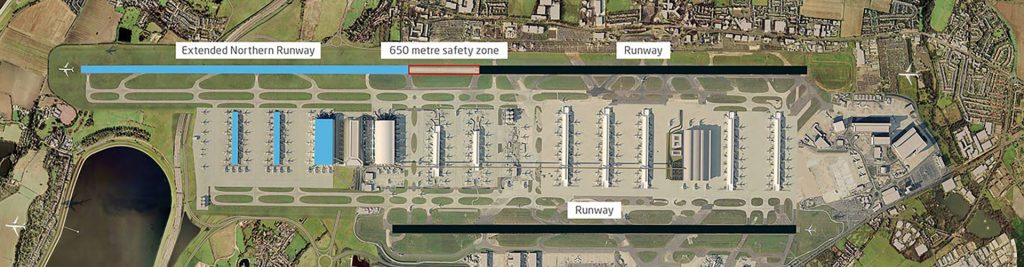
The Extended Single Runway
The Extended Single Runway is an innovative solution for a safe, rapid, and less environmentally damaging means of increasing airport capacity. It is suitable for deployment at multiple airports around the world.
The system can substantially increase capacity, taking the typical number of ATMs / hour from 45-55 on a single runway, operating on mixed mode, to 80-90 ATMs on a single extended runway. On an extended runway, aircraft land and depart from separate runway strips, separated by a central sterile safety area. The design allows for fully independent operations and is compliant with missed approach/baulked landing procedures.
The design delivers significant benefits for airports considering expansion or looking to reduce environmental impacts as it is predicated on the following specifications:
- Minimal land-take
- Reduced impact on property and infrastructure
- Optimal airport efficiency
- A much-reduced cost than a traditional, parallel runway
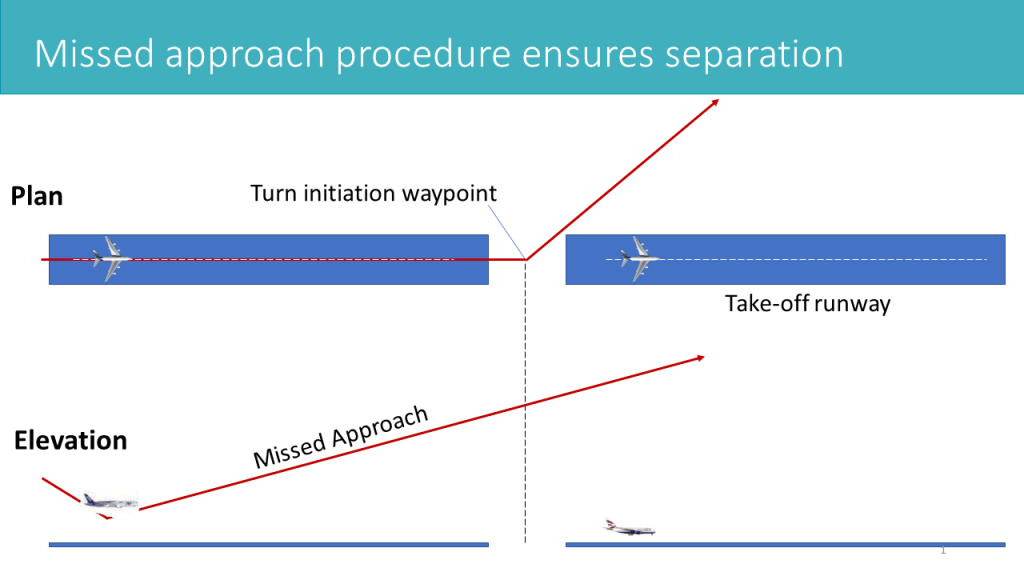

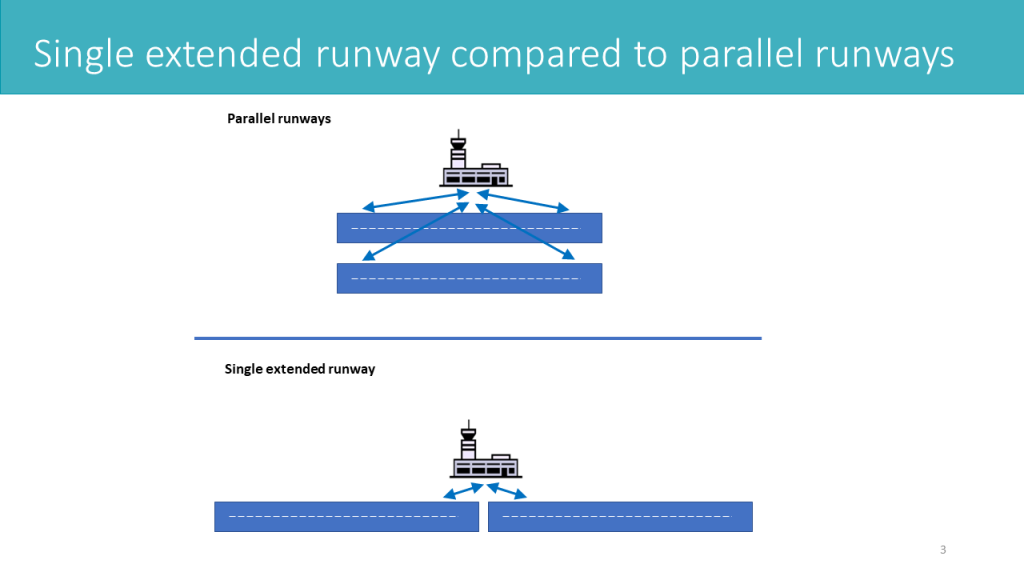
Benefits of an Extended Single Runway
Safety and Efficiency
- The Extended Single Runway has been designed to meet internationally recognised standards: International Civil Aviation Organisation (ICAO), European Union Aviation Safety Agency (EASA) and Federal Aviation Administration (FAA)
- The minimum safety area required by international regulations is 300m but in the case of Heathrow the safety area was designed to be 650m, to further enhance the safety case
- The system includes suggestions for air traffic control operations, designed to further enhance safety and environmental benefits
Environmental
Land
- Much lower land take including the potential to shorten existing runways
- Allows airports to increase their capacity by lengthening an existing runway rather than laterally where land is often restricted
- Less build and less property acquisition resulting in lower cost and less controversial to deliver
Emissions
- Potential for a 40% reduction of airport related CO2 emissions compared to alternative methods of increasing capacity
- Reduction in the need for runway crossings and end-around taxiways resulting in less ground congestion
- Less ground congestion
- Shorter taxiing distances reduces fuel burn and emissions
Noise
- Reduces need for airborne crossings and High Side/Low side procedures and consequent noise impacts
- Reduces over-flight of new communities
- Allows for managed respite of affected communities via curved, offset, and angled approaches
Cost and Logistics
- Redevelopment costs up to 30% lower than traditional parallel runway solutions to achieve an equivalent or greater increase in capacity
- Allows for simpler Air Traffic Control and airspace design
Third Party Endorsements
A lot of innovation went into the Heathrow hub proposal, and we considered it very carefully when we reached our initial recommendation. I have no doubt that its promoters, who are smart people and who have developed some innovative ideas, will be using those ideas to encourage change in other places around the world and hopefully building an international business for themselves
UK Secretary of State for Transport, HM Government. 5th June 2018
…Called for an extension to the airport’s northern runway saying that it was the only way to create extra capacity at Heathrow without vastly inflating costs for travellers and driving away airlines. The move represents his strongest endorsement yet for the so-called Heathrow hub plan
Willie Walsh, ex – British Airways Chief Executive. The Times, 23rd June 2016